
Demonstrating > Protesting
Thinking about plurality


I went to a talk about six months ago that I haven’t stopped thinking about since.
The talk was hosted by Jon Alexander in conversation with Audrey Tang.
I bought Audrey’s book, Plurality, on the spot.
That book is now in transit by boat across the Atlantic Ocean. As many of you know, I moved back to my hometown in Virginia three weeks ago. I see people holding signs on the side of the road that say things like “Save our democracy” and “Respect the Constitution.” It feels like waving a finger at a charging bull.
I keep finding myself thinking, there has to be another way or else we are absolutely f*cked (maybe we already are). My thoughts keep returning to Audrey Tang and Plurality.
Plurality is a vision for participatory, decentralised, transparent governance. In other words, networks.
I hope this gives you something to hold on to.
Demonstration is better than protesting 🔥
The basic idea is this:
Protesting is about registering your opposition to something, about standing up and saying I don’t agree. Protesting has a place but it’s not often a tool of long term movement building.
Demonstrating, on the other hand, is about actually creating what you would rather see in the world. It’s about developing and living in the future we want to see now. Audrey argues that building and showcasing viable alternatives offers a much more compelling narrative.
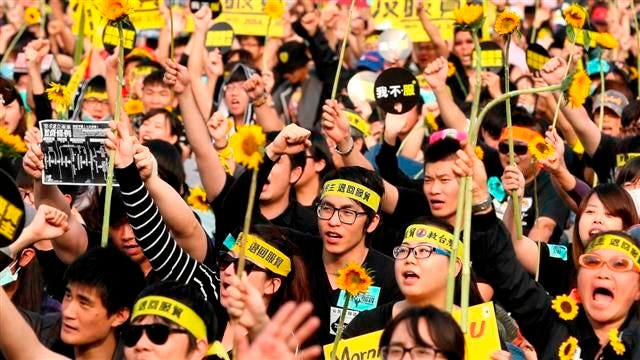
Skip this if you don’t want the back story: Audrey Tang was a member of Taiwan’s Sunflower Movement in 2014, and went on to become Taiwan’s first Digital Minister. The Sunflower Movement started when young activists occupied the national assembly for 3 weeks to oppose a trade agreement with China.
At the same time, hack-tivists built digital tools for public participation. They essentially took government data that was presented in a completely illegible way and Using g0v (gov-zero), an open-source platform, they re-listed in information in a way people could actually understand and invited the public to contribute to alternative proposals.
But here’s where the movement differs from something like Occupy Wall Street from the same era. It worked. After 3 weeks, the government agreed to halt the trade deal.
But it also completely changed the way the government in Taiwan approached citizen engagement.
Basically, people want to create things together, they want to participate. They also want to see what they are buying in to. It was much easier for the Taiwanese government to adopt the idea digital democracy because they had already seen first hand how well it worked on g0v (gov-zero).
We can’t wait for permission to build the future.
Giving trust is the best way to get trust 🤝
I talk a lot in my work about the idea of a ‘trust recession’. Only 46% of people in Western democracies trust their government, and just 26% of people trust institutions more broadly (Pew).
On the other hand, when Audrey left her position as Digital Minister, approval for the government was at 70%. And it’s no accident that Taiwan is bucking the trend of democratic backslide.
Audrey explained the the Guardian, “To give no trust is to get no trust. When you radically trust citizens, citizens will trust you back.” You can read the full article here.
This means that institutions should be as transparent and collaborative with the people they serve. For example, during Taiwan’s COVID-19 response, Tang and her team used open-source tools, real-time data dashboards, and citizen-driven mask distribution tracking to ensure transparency. And they had one of the best pandemic responses in the world.
Reverse mentoring is a thing 🌱
The idea is simple, basically, we assume that young people know nothing and that they need to learn from us to prepare for the real world.
However, the Taiwanese government implemented a reverse mentoring scheme where Ministers were paired with a young person to teach them things about the internet and living in the real world.
As a not even very old person, would love to have a young person explain the internet to me.
I think this is such a good idea and from a relationship building perspective, its brilliant as well because it turns the power dynamics on their head.
Basically, I want someone to hire me to run a reverse mentoring scheme at some point, just putting that out there💭
Let’s demonstrate together
There’s a few reasons that I’ve been obsessed with Audrey’s work. I love that it’s an example of using tech to unite us and distribute power instead of divide us and accumulate power. Having previously only experienced legacy social media, I came into the talk as a techo-pessimist and left as a techno-possible-ist?
But at a more basic level, I love the idea that if we give trust and transparency and opportunities to meaningfully engage to people, they take it. A lot of traditional western democratic thought is based on the idea that the people don’t actually know what’s best for them. This completely flips that idea on its head.
On a recent call, someone said to me, “I believe that we’re surrounded by genius. Everyone has something to give.” What a generous and open way to view the world.
If that’s the future, sign me up, let’s demonstrate.
p.s. a big thank you to these incredible patrons of the arts: my mom and mother-in-law are officially my first paid subscribers. Join their illustrious ranks and I’ll shout you out too!
Read this pierce in the morning was thinking during the day, and re-read again, adore it on all levels, thank you for writing it and introducing to the story I've also never heard before. Lead by example is also something that comes to my mind <3
What a great read - concise but very informative! The difference between defending versus demonstrating is massive and not many people have the power to demonstrate as this takes resources, like time or tech. Its great to see governments leaning into this participation plurality as a tool though- love a positive example! Saving this! 👏🏽